


Neurodynamic Testing
Changes the Game.
Let's look at a scenario that plays out far too often...
Someone has leg pain and gets told that they have "sciatica," or "periformis syndrome." While these labels sound credible, they don't dictate course of treatment unless someone actually tests to rule them in or out. The truth is that several very different mechanisms can look and feel nearly identical on the surface.
The McGill Method assessment is built to identify the dominant cause of your symptoms ---pain, tingling, numbness --- so that the treatment plan is targeted to specific cause.
The moral of the story, if the testing isn't precise then you're only treating a label and outcomes become hit-or-miss, rather than predictable and intentional.
Why is do you have pain running down the leg? Why does your foot tingle, or feel numb? Why when you sit one way your symptoms come-on but if you sit another way the symptoms fade? Why is it that you're MRI report basically says nothing's the matter but your body is telling a different story.
That’s where precise testing matters. It's non-negotiable.
When symptoms seem to skip the back and travel down the buttock, or into the hips and lower limbs (i.e. thigh, calf, or foot) there can be multiple possible reasons, not all of which show up clearly on an MRI.
In cases where leg symptoms behave like nerve involvement (see our nerve pain discussion below to understand what nerve pain feels like), we add a specific layer to the McGill Method assessment: Neurodynamic Testing (NDT). NDT helps us sort out why you’re experiencing the particular mix of symptoms you have, and what to do about it.
What is Neurodynamic Testing?
Our nerves are like long, elastic, continuous cables wrapped with a casing. Just like a bicycle cable must be able to slide freely inside its housing as it moves, your leg nerves must be able to glide and tolerate movement as they pass through surrounding tissues -- muscles, ligaments, bones, and joints. In practice, the sum of these surrounding tissues is referred to as the "interface."
But sometimes these nerves, for one reason or another, don't tolerate movement or load as well within the interface. When this happens, a orchestra of symptoms can appear such as: pain, tingling, numbness, burning or "electric" sensations that need to be tweezed out.
Neurodynamic testing is a hands-on physical assessment that helps us practitioners to determine which structures and mechanisms within the interface are causing the symptoms rather than guessing based on labels.
Neurodynamic Testing helps us to determine whether:
-
Something pressing down on the nerve
-
Inflammation around the nerve is preventing it from gliding freely
-
A nerve that has become irritated and sensitive
-
A segment of the spine that is ustable and repeatedly irritating nearby tissue
-
Or a mix of these factors
And the quality of our testing is capable of determine a more precise course of treatment. For example:
👉 If the problem is too much stretch we can adjust posture and positions.
👉 If your symptoms are due to compression we change for instance how you sit, and move to offload the nerve.
👉 If its due to a disc bulge, we use positions of relief to reduced it's size and calm symptoms.
👉 If the nerve is trying to move through clogged-up inflammatory soup, like a clogged drain, we restore its ability to glide with very gentle movements.
👉 If the spine is unstable, we build stiffness, control, and endurance to stop the repeated irritation.
Without testing, these problems all look the same. But each one requires a different plan.
This is where precision counts!
Instead of random stretches, generic core exercises, or repeated flare-ups, you leave knowing:
What is driving your leg pain
What movements, postures, or positions to avoid (for now)
What to work on,
And most importantly why you are doing it!
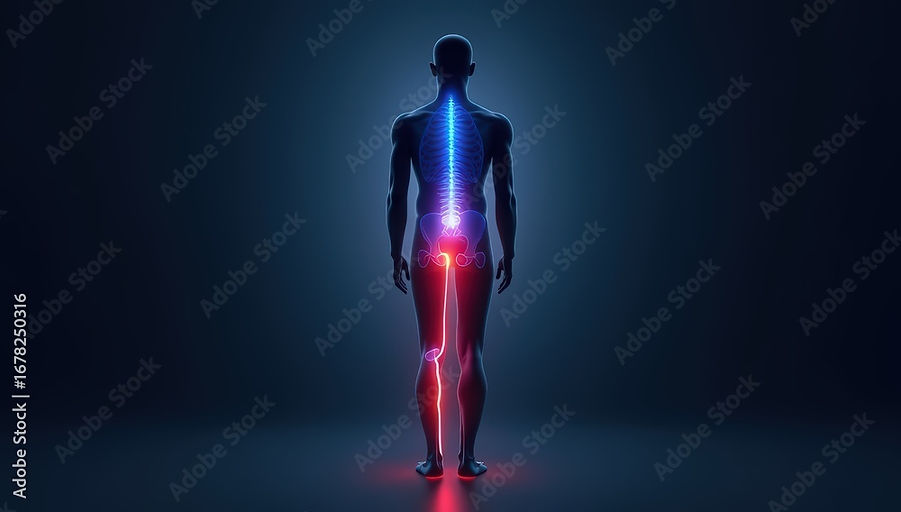

What do nerve symptoms feel like?
-
Usually pain that travels below the glute
-
Burning, zapping, or electric sensations
-
Pins and needles
-
Numbness
-
Sometimes cramping with prolonged sitting
-
Symptoms that worsen with rounding the back flexion
-
Pain that fluctuates with certain movements.
Not all leg pain is nerve pain. And not all nerve pain is caused by the back or its discs. That’s why we test first, then decide after.
How we integrate Neurodynamic Testing
within the McGill Method framework
The McGill Method begins with a detailed history and a movement-based mechanical assessment.
The objectives of this assessment is to identify:
-
Which movements your back doesn’t tolerate
-
Specific postures that provoke or reduce symptoms
-
The loading pattern driving symptoms
-
Signs of instability
When nerve symptoms are present, neurodynamic testing becomes a critical additional layer.
This allows us to determine:
-
Is the nerve mechanically sensitive?
-
Is the nerve restricted in mobility?
-
Is the nerve irritated but moving normally?
-
Is the spine the true driver, with the nerve simply reacting?
This prevents mislabeling someone as having “tight hamstrings,” “sciatica,” or “piriformis syndrome” without evidence.
What does Neurodynamic Testing actually test?
Neurodynamic testing seeks to answer one clear question:
If the nerve is the true source of pain, where exactly is the nerve getting pinched or stuck and how sensitive is it?

The Process:
During the assessment you will be placed in specific positions, or moved in specific ways that gently challenge the lower limbs and back while we observe your response.
These responses tell us whether:
-
Is spine is the primary source and the nerve is merely reacting, or,
-
Is the nerve itself the source, and if so where?
This is why precision matters.

If a nerve is truly sensitized:
Stretching can and most often make your symptoms worse after a period of relief.
Repeated spine flexion could trigger symptoms if the disc is involved .
Poorly prescribed mobility work can prolong irritation.
If the spine is unstable:
-
Neural symptoms may be secondary to repeated shear or flexion loading.
-
Stabilization becomes the priority — not nerve glides!
If true nerve movement restriction exists:
-
Targeted neurodynamic interventions can restore glide and tolerance safely.
-
Dosage and progression must be exact.
There is no guessing in this process.